
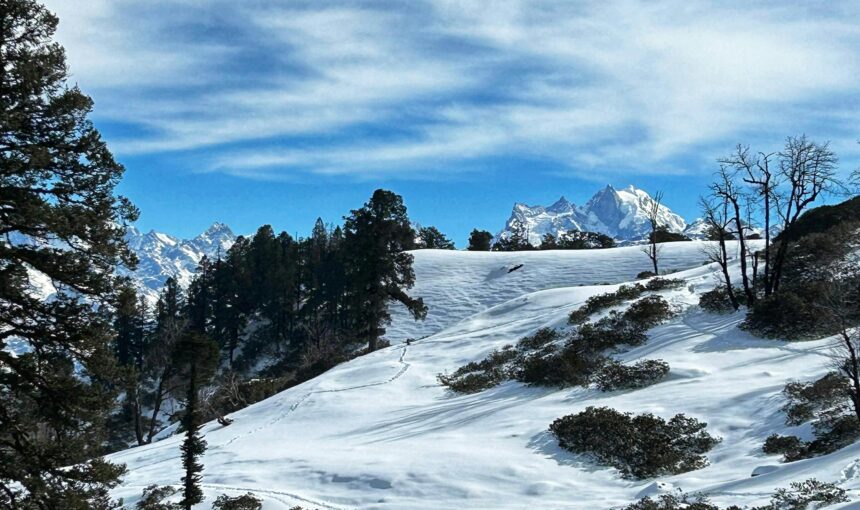
The air is cold, but the silence is colder. Somewhere far below, a stream gurgles beneath a layer of ice. Pine trees stand tall, dressed in snow, their branches gently swaying in the wind. And up ahead, a narrow white trail winds its way to a peak that catches the first golden light of dawn.
This is Kedarkantha.
A winter trek unlike any other, Kedarkantha is where many first fall in love with the Himalayas — not just for their grandeur, but for their gentler, quieter moments. It’s the crunch of snow beneath your boots. The hush that falls across a campsite at night. The orange glow of a sunset reflecting off a frozen lake.
It’s not just a trek. It’s an experience that stays with you.
Where the Journey Begins
The trail to Kedarkantha begins in Sankri, a remote village nestled in Uttarkashi district, surrounded by the dense forests of Govind National Park. From the moment you arrive, the shift is palpable. No traffic, no rush — just crisp mountain air, kind faces, and views that stretch far into snow-kissed valleys.
The early stages of the trek take you through forests of oak and pine, often layered in fresh snow during winter. Light filters through the branches, creating patterns on the trail. The gradient is gentle, making it ideal even for first-time trekkers — but it’s the scenery that steals the show.
Campsites Like Postcards
Each campsite feels like stepping into a postcard.
Juda ka Talab, a small alpine lake frozen solid in winter, sits surrounded by forest. Trekkers often gather here in the evening, sipping tea around a fire, swapping stories as stars emerge above.
At Base Camp, the night sky is unreal — thick with stars, clear and undisturbed by city lights. There’s a stillness in the mountains that can’t be described, only felt.
The Summit Push
The final ascent to the Kedarkantha summit usually begins before dawn. Headlamps light the path as trekkers move silently up the snow-covered ridge. Slowly, darkness gives way to soft hues of pink and gold on the horizon.
And then, just as the sun breaks over the peaks, you reach the top.
The view is a full 360° panorama of the Garhwal Himalayas — Swargarohini, Bandarpoonch, Black Peak, and distant snowfields stretching as far as the eye can see. In that moment, all the cold, the tired legs, the early wake-up — it all fades into something bigger. Something still.
It’s not just about conquering a summit. It’s about what the mountain gives you in return.
The Aftertaste of Silence
Coming down from Kedarkantha is often slower. Not because the trail is difficult, but because no one really wants to leave. There’s something humbling about the place. The simplicity. The clarity it brings. The feeling of being both small and whole, all at once.
When to Go
While Kedarkantha is accessible most of the year, it’s winter — from late December to March — that transforms it into a snow-draped wonderland. Trails are covered in white, trees wear frost like jewelry, and the sky seems clearer than ever.
For those new to high-altitude trekking, this is the perfect introduction — challenging enough to feel accomplished, yet safe and approachable for beginners with moderate fitness.
Final Words
The Kedarkantha trek isn’t just about reaching a summit — it’s about everything in between. The quiet forests, the frozen lakes, the laughter at campsites, the awe at sunrise. It’s a reminder of how much beauty the world holds when you take the time to walk slowly, breathe deeply, and look up.
Whether you’re chasing snow, solitude, or simply the thrill of trying something new, Kedarkantha will welcome you with open arms — and probably send you back a little different than when you arrived.
This trek is part of our winter trekking calendar at Hike&Seek, for those who want to experience the Himalayas in their purest, snow-covered form.